














HOME | MEET JOAN & BOBBY | SITE MAP | E-MAIL JOAN |

Our Family History

“Tell ye your children of it, and let your children tell their children, and their children another generation.” JOEL 1:3

I wonder if a "Missing Persons Bulletin" would locate ....

Genealogy:

A search for the greatest treasures ... our ancestors.

Hindsight is the necessary tutor of foresight.


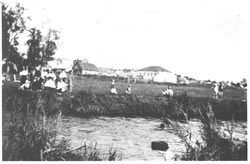
NOTE: The photo above (on the right) is of Wysokie-Litovsk pre-WWII.


History of Wysokie-Litovsk


The POMERANTZ, and particularly the DUBINER/RUBIN families, came from Kamenets-Litovsk and Wysokie-Litovsk. The two towns were in very close proximity.
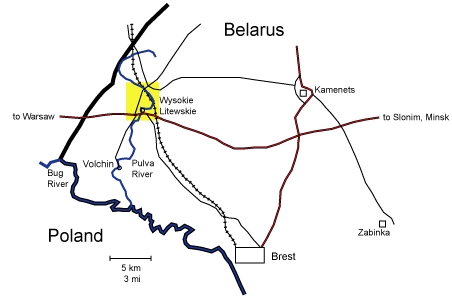
WL and Kamenets


Vysokoye means "upper" as in Upper Litovsk . It is a town in the Kamianiec district, Brest region, 40 km West of Kamianiec, and a station on the railway line Brest - Vysoka-Litousk.

There are various spellings: Wisokie-Litovsk, Visoky-Litovsk, Vosokie- Litew, and Vysoko-Litovsk, among others. The Yad Vashem search finds at least the following:

-- all listed in Brest Bugiem (Brest-on-the-River-Bug) District, Polesie Region, all --I think-- referring to the same place.

The most striking feature of old W-L was a marketplace, a square surrounded by high, thick walls that must have dated from medieval times. At the center of the marketplace was a large water pump and a pool. There was a large open space surrounding the pump, dirt-floored and quite dusty most of the time. In this space, people would "park" their horse-and-wagons, or set up small sales points, as simple as a peasant holding up some vegetables.
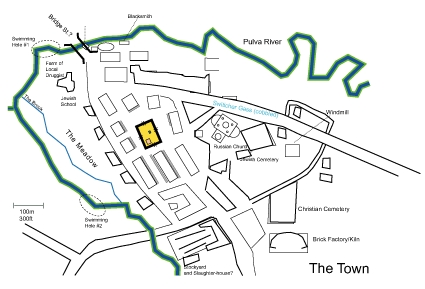
WL Town Map


Inside the periphery of a tall stone wall, there were booths facing the center of the square. There were temporary habitations behind each booth, possibly built into alcoves on the inner side of the wall. The wall was pierced on each side by an arched passageway. Outside the wall there was a road around the entire periphery. Partly lining the road were groups of storefronts facing inward, each with raised sidewalks.

At the west side of the square, there was a synagogue: the old or "high" synagogue, so named by the need to ascend steep steps to enter.

Jewish community election flyers (written in Yiddish) for the year 1939 refer to the shtetlakh of Kamenetz-Litovsk, Wysoko- Litovsk, and Verkhovitsh (+/- 35 kms N of WL) as belonging to the same RAYON and as electing common kahal representatives. This might explain why some services, such as the fire-brigade, and some obligations, such as filling the military recruitment quota imposed by the Russian Imperial authorities, were met in common by these shtetlakh.

List of W-L societies in the US and their respective cemeteries:

Wisoko Litowsker Bruderlicker Unt. Verein, VYSOKOYE, BYEL? --- Wellwood, Block 29, Section 2, Landsmanshaft

Wisoko Litowsker Bruderlicker Unt. Verein, VYSOKOYE, BYEL? --- Mt. Judah, Section 2, Block 6, Landsmanshaft

Wisoko Litowsker Bruderlicker Unt. Verein, VYSOKOYE, BYEL? --- Washington (B'klyn), Section 5, Post 497, Landsmanshaft

********************************************************

Jozef Charyton grew up in Wysokie Litewskie. Although not Jewish, he was well-integrated into the Jewish community. As you will see below, he was sympathetic and very interested in understanding and recording the people of the community.  His works offer a rare glimpse at the society of our ancestors.  His father ran or owned the electrical generating station in W-L.   Charyton was an artist-painter, and also very interested in philosophy and parapsychology.  He may have worked at the W-L railway station.  After the war he settled near W-L on the other side of the border, at Nurzec, where he taught painting and followed his other interests.  He was married and had two sons.  He died in 1975.


The works of Charyton are in collections in several museums.   The most prominent is the Jewish
Historical Institute in Warsaw, that holds 125 visual works reflecting Charyton's presence at the mass murders in Wysokie Litewskie by the Nazis, and another sixty that are pre-war portraits of Jews from Wysokie Litewskie and Kamenets.


Jozef Charyton writes:

Wysokie Litewskie under the Hitlerian [1] Occupation


I spent my youth in Wysokie Litewskie.   I went to elementary school there. I made my first friendships in Wysokie, and formed my artistic interests. My young Jewish friends liked me and I was absorbed into their cultural lives.   I painted for them; my first landscapes hung on the walls of their homes.   I helped paint the sets and decorations of the amateur theatre, so much so that never a production went forward without my contribution.

I had many friends in the community.  One lasted to the very end ­ my friendship with Moses Teitelbaum, a poet and short-story writer, whose works were already published in Jewish magazines.   Even though I left to study at the Academy of Arts in Cr ac ow , I kept in cont ac t with my friends in Wysokie. During summer v ac ation, I returned to continue our long discussions of
various themes of importance to the inner life of our generation. I got to know the customs of my Jewish friends; I was invited to their family weddings and to holiday feasts.  I participated in their joys and sorrows. I was not a stranger to their loves and longings, full of specific folklore --
an exotic weave of local and Middle-Eastern elements.

By then I had ac quired some significant skill, and I used it to paint scenes of the local marketpl ac es, and to capture typical char ac teristics of the people I saw.

At the same time I got to know Kamenets Litewski, where there was an Academia Duchowna [4]. Students at the Academy included young people from the countries of Western Europe .  That gave me the opportunity to draw differing types. [5]

Staring in 1939, and during the entire German occupation, I lived in Wysokie Litewskie.   After the beginning of the war and the att ac k on the Soviet Union by the Germans, I was elected by the temporary city council as a manager of economic ac tivities in the town.   My duty was to give bread to 6000 inhabitants [6] and safeguard their personal property.     This was not an easy job, especially as the Germans kept involving themselves in every detail of my work.

I ac ted humanely and became closer to the hearts of the Jewish popul ac e. Even more so when I officially took a stand against the harassment of the inhabitants by the local temporary police, who were under German control.  I held that position until power was taken over by the Amt Komisariat [7] after 5 months of "anarchy". [8]

I watched the Jews build the Ghetto with their own hands. I knew then that some horrific trap was being prepared.   I kept a diary, I checked all the f ac ts, and I felt compelled to be everywhere and see everything, even though this took me some very dangerous pl ac es.   Some unresistable desire
was pushing me to witness the History.  At times this desire pl ac ed me in situations dangerous to my own life.  On the outside, I was calm.  I never gave any reason for suspicion to my German bosses.   Under various pretexts, I kept on visiting the Ghetto.

I observed the life of the stifled Jewish community and I returned to my studio, where I sketched compositions which I intended to serve for future works in oil.    I lived right next to the ghetto and very close to the anti-aircraft observation point. One night I was awakened by the sound of a
m ac hine gun.  In the morning, I saw a few corpses lying before my windows. The same thing happened in other parts of town.

The Jews realized that extermination was appro ac hing.   They attempted a mass escape through the weakest points in the fences, after preparing the way in advance.  [However], it is highly likely that only one of them avoided death, because the Germans had posted m ac hine guns to guard all the weak points of the Ghetto.

From that point on I began to carry a camera, which --unfortunately—I never used at the right moment.

From that moment on began the full tragedy and mass murder:

The Germans divided the human mass into three parts. In the morning towards the end of January 1942, they took the strongest [young] people out of the town, on the pretext of working in the forest.  All carried wood-saws.   I could not see the entire column of people clearly, because as they left town they were surrounded by units of foot- and mounted soldiers.   At that point, the march changed into a wild run;  the Germans in the rear were urging them on with whips.     The weaker of them, and those with heavier loads [9], began to drop their bundles.  They were not allowed to pick them up.

I was very sorry that I could not see more of that tragi c l ast march.  So, I decided that at any price I must see the next stage, which occurred two days later.     I joined them when they assembled, and I walked along with them all the way to the outskirts of town to an open field.  There they were met by armed units.   I was able to hide among the trees on the side of the road, and from there, unobserved, I could see the entire area.   [10]  The third part and the last one contained women, girls, children, elderly, and sick, which were carried haphazardly on horse-drawn wagons like firewood.


It was one of the most horrifying pictures under the sun, which encapsulated the entire martyrology and murder [11] of the Jews.   This group stretch out despite the f ac t that the rearmost people were rushed forward, under heavy beatings, by the Germans, so much so that when the front-most of the column re ac hed the railroad station [12], the rear elements were still leaving the town.   Among the violations, screaming, and beatings of the victims, the Hitlerians lost control.  You could see that they were scared and nervous.

I was invisible to the Germans as I walked b ac k and forth on a parallel path some 10 meters away, pretending to be on some errand or another.

Many people could have escaped during this march, but none did.  They were bound by the bonds of family, children --as if not wanting to leave the children alone/behind-- or were simply powerless or half-conscious.

I got to the train station and stopped between posts [13].  Before me, there was a square crowded full of people waiting for the others to arrive. The scene of loading was shocking.  The people were being pushed like cattle to slaughter.  They were beaten and driven in front of horses.  They crawled all over e ac h other's heads --leaving clothing, shoes, head coverings [14]-- and were loaded quickly ­ in 7 - 10 minutes.

Sometimes a train like that was loaded all day by a few hundred people. [15] After being loaded, they locked the boxcar doors, and the locomotive pulled them in a known direction, "N ac h Treblinka" [16].

Was I able to take in everything with my eyes?  My eyes are very sharp, but I only had two of them.   And I made the sketches several days later.  [17] At the end of February, a new horror began.   Some Jews had prepared hiding pl ac es in basements. Unfortunately, they must have given themselves away. Or, here and there, careless people gave them away .

The searches began.  If they found up to a dozen people, they were shot on the spot, depending on the situation.  Later, they [the Germans] gathered them in the synagogue [18]; victims were taken out a couple of dozen people at a time, lined up [19], and shot.  This occurred right behind the tannery, which I could enter because I had been managing a wool-processing workshop
there.

After checking the ditch [20] in the evening I would lock myself up for the night and wait for the morning.   In the morning, I cleared the frost on the glass window and waited with my camera.  I had a very good field of observation:  I could see Count Pototsky's pal ac e, from which a unit of
soldiers appro ac hed.  From the other side I could see the synagogue from which they [other soldiers] were bringing victims.   I had a panoramic view, and I could see all the ac tivities on the roads leading to the ditch, which was about 20 meters [60 feet] from my position.   I could not use my camera because I had at that moment a realization of hopelessness, just like this life of mine, and the camera dropped from my hands.  Only shortly afterwards I took a few pictures of the victims, their blood steaming in the cold.

[After shooting the victims] the Germans left immediately, as if they were disgusted with their job.   So, right away, I went out to the ditches.  I was there when the bodies were stripped of the bloodied clothes and were covered up, still moving and making wheezing noises.  But I did not
recognize any f ac es.

I returned to my studio and my drawings.  I had grand plans to recreate these most horrible scenes on giant canvasses for history.  Unfortunately, the l ac king financial means, the forced deportations,  the l ac k of permanency, and many other reasons undermined my plans.    Many works [21] were lost during the war. Many went to friends, among them Professor Jan ______ [22] of the Jagiellonian University [in Cr ac ow ], and Father Prelate Wroblewski of Hajnowka.  Both of these men were from Kamenets Litewski, where I met them.   The rest, the largest part is in the hands of the Jewish Historical Institute.

[Written in the town of]  Nurzec   February 6, 1963

[signed] J. Charyton

The above statement of my activities I have written on the request of the Jewish Historical Institute for the collection of works on the Martyrology of the Jews.

NOTES:
[1] "Hitlerians" is common Polish usage to describe Nazi Germans, a usage created by the communist new-speak to create a sense that the East Germany consisted of good Germans and West Germany is the decendant of the Nazis and supported by the USA .

[2]  "Martyrology"  used narrowly means a catalog and calendar of Catholic martyrs and their days.    This broader usage means a description of the events of martyrdom.   Most generally, this appears to be an ac knowledgment of the innocence of these victims and a sense that their memory is to be honored.

[3] Apparently the Germans removed  Jews  from their homes in Kamenets Litewskie, about 20 miles north-east of Wysokie Litewskie, and housed in the Ghetto of  Wysokie.  Thus, they shared the fate of the local Jews.

[4] By implication, a school for training rabbis.

[5] "Types" was a common term used by European artists to denote people of differing stations of life, often with interesting appearances, worthy of being depicted in an artistic work.

[6] The original inhabitants of the town, about 3000, plus others brought in my the Germans, including Jewish residents of Kamenets Litewskie as mentioned above.  Thus, living conditions in the Ghetto were very likely terribly crowded.    Andrea Simon's book "Bashert" documents that the
Germans told the residents of neighboring Volchin that they would be removed to the "more comfortable" Ghetto at Wysokie Litewskie, and this pretext was ac cepted, implying that the pr ac tice was commonpl ac e.  In the case of Volchin, the residents were murdered on the outskirts of that town.

[7] Apparently, a German special unit with specific occupation/police duties. [8]  This may refer to the period immediately following the German invasion of the Soviet Union .  There must have been some time before the German administration arrived, and ­in the meantime‹there was an absence of authority of about 5 moths.

[9] By implication, the victims may have been carrying their own food and bedding, for an extended "assignment" in the forest.

[10] The original Polish document omits any transition between the incomplete description of the fate of the second group, and the removal of the third group.   There is no clear reason the author made this choice. Possibly, he is referring to the work parties as the first group, the aged, sick, and elderly as the second group, and the detection and murder of remaining Jews hiding in basements as the third.

[11] Again, the author may be drawing a parallel between the treatment of the Wysokie Litewskie Jewish victims and that of Catholic martyrs at the hands of their tormentors.  Or, this is a non-sectarian reference to innocent victims who perished in a mass murder.

[12] The Wysokie Litewskie railroad station was about 5 km or 3.5 miles to the northwest of the Jewish community and the Ghetto.

[13] "Posts" may refer to loading points or platforms.  Evidently, the author stood aside to observe.

[14] ³Head coverings² may refer to the religious articles.

[15] As given in the original.   The meaning or implication is not clear.

[16]" N ac h Treblinka" German: "Towards Treblinka".   Translator's note: It seems very unlikely that the author knew at the time the destination of the trains; probably, he added this later on, after the war.

[17] Perhaps an apology for not recording all the details, or an expression of the enormity of the horror he witnessed

 [18]  Very likely, the "New Shul", the ruins of which are visible in many modern photographs. However, the "Old Shul" was nearby, and there is some info rmation that it had been converted into a jail by the Germans, so it is possible this was used, or possibly both.

[19] The Polish verb implies this particular style of execution.

[20] Apparently, the Germans followed their common pr ac tice of lining up their victims in front of a ditch before shooting them, so their bodies would fall directly into the ditch.

[21] This unclear transition occurs in the original text.  It seems the author did eventually create artwork based on his observations of these murders -- and possibly, of pre-war Jewish life.   See   http://www.culture.pl/en/culture/instytucje/muzea/in_mu_instytut_zydowski for more on the museum.

[21] The name of the professor is omitted in the original text.

***************************************

Aida from the W-L research group wrote the following:

To all the group,
I happened to recently read an article in hebrew about the shtetl of our parents and ancestors. Among many things it tells us about the shtetl it says that the Jews were merchants, artisans, and shopkeepers; they produced brandy, beer, had three watermills for grinding flour and were horse and cattle-dealers.The shtetl was famous in the first half of the 19th century for its yearly fair in the month of July that lasted for two weeks. In 1886 they opened an elementary Russian Jewish school with 50 pupils. They had a talmedteyre and a kheyder besides.There was also a Jewish hospital in town.The old synagogue (built in 1607) was brick-built and the building was refurbished in 1827. The second brick-built synagogue (built in 1657) was refurbished in 1850. The shtetl was privately owned and belonged from the beginning of the 18th century to the princely family of Sapega, or Sapeha, who had a castle, a hospital, and a church built there. When the shtetl became part of Poland in 1919 the Polish authorities opened a school whose language of instruction was Yiddish but in 1929 the construction of that school building remained unfinished for lack of funds so they had to move to the orphanage. According to this article, because of its proximity to the border, the Germans entered the shtetl already on June 22nd 1941, and immediately established a closed ghetto for the Jews, who made up 80% to 90% of the population, to which they added the Jews they brought over from other shtetlakh (Kamenets Litovsk, for e.g.) and nearby hamlets (Rasno for e.g., at a distance of 3 km from WL). They liquidated the ghetto on November 2nd 1942. This article says that some young people ran away to the woods  but we all know that none of them survived. Needless to say that the majority of the non-Jewish population of the shtetl did survive the war. Hope this has been of some use and/or interest to some of you as there is very little to be found about the shtetl and there has never been a proper yizkorbukh published that we are aware of.


ÜPomerantz History Page

ÜDubiner History Page


WARNING AOL USERS! This site is best viewed using Internet Explorer. AOL users should use Explorer in conjunction with their AOL connection rather than using the standard AOL browser.

DISCLAIMER: THIS IS WORK IN PROGRESS. WE ARE NOT SURE THIS INFORMATION IS ENTIRELY CORRECT, AND WE KNOW IT IS INCOMPLETE.